What the Noida Aqua Line Metro extension means for the residential and commercial real estate markets along the Expressway
By Bricksnwall | 2026-02-16
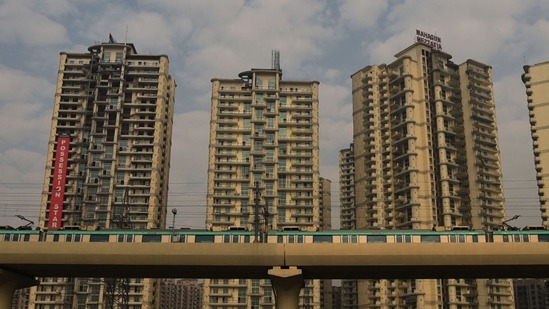
The Aqua Line Metro extension in Noida will
change how people get around on the Noida Expressway, which will have an effect
on the housing and commercial real estate markets.
The Union Cabinet accepted the comprehensive
project report and gave ₹2,254 crore for the 11.56-km Metro Link extension of
the Aqua Line. This has greatly improved Noida's connectivity. When it opens,
the corridor will make it easy for people to switch between the Delhi Metro's
Blue and Magenta Lines and Noida's Aqua Line. This will fill in a long-standing
gap in connectivity for people who use the 25-km Noida Expressway segment.
There are a lot of IT and ITES parks,
corporate offices, and big apartment buildings along the Expressway corridor.
Right now, people who travel have to switch trains at Sector 52, which can take
a long time to go only 12 km. The new link is supposed to make it much easier
to go to Delhi, IGI Airport, and key train terminals and cut down on travel
time by a lot.
The project will have eight elevated
stations: Botanical Garden and Sectors 96, 44, 105, 93, 97, 108, and 91. It
should be done in four years. The corridor is also supposed to help ease
traffic on the Noida Expressway by making it easier for people to switch to
public transportation. Improved workplace mobility and easier access to talent
are likely to help key business centers including Advant Business Park in
Sector 142 and corporate campuses in Sectors 126, 132, 145, and 157.
Experts in real estate think that the project
will make it easier for people to get from Delhi to the residential areas along
the Noida Expressway, which will boost demand even more. Commercial rentals in
the micro-market, which have already been steadily rising, are projected to get
much more business. In the residential market, the effects will probably be
more obvious in the secondary market, especially in the ₹2–3 crore range.
Deepak Kapoor, director of the Gulshan Group, told Hindustan Times Real Estate that improvements to infrastructure usually have a direct effect on real estate activity. He said that better metro connections should have a good effect for both residential and commercial properties along the corridor.
Effect on business real estate
On the office front, this connector, once
operational, will make it easier for entry-level employees to commute, widening
the available talent pool. Companies generally choose office buildings close to
metro stations because they help them find and keep good employees more easily.
He noted that better access to public transportation can also help women who
rely on third-party transportation, making it easier for them to get to work
and increasing their involvement in the workforce.
Commercial rentals in the micro-market have already grown a lot. IT office rentals that were around ₹45–50 per sq ft three years ago have risen to ₹65–70 per sq ft. The same is true for renting commercial office space, which has gone up from roughly ₹60 per square foot to between ₹70 and ₹100 per square foot. He noted that with better metro connections, this momentum is likely to grow even stronger, which will speed up absorption and rental growth over time.
The effect is likely to be stronger in the secondary housing market
In the residential sector, the effect is
projected to be more in the secondary market, especially in the ₹2–3 crore
range, where better connection may lead to higher interest. On the other hand,
the primary market is mostly driven by supply. There aren't many land parcels
along this area, and they are pricey, so mid-range purchasers can't afford new
launches.
To stay in business, developers are now
concentrating on high-end and ultra-high-end projects. Kapoor said that
developers now have to pay the government the full cost of the land up front
because the old 10% payment plan is no longer accessible.
Make traffic less crowded
The Aqua metro line extension is expected to reduce traffic on the roads, improve access to the airport and major train stations, and encourage more people to use public transportation. All of these things are expected to help real estate growth along the Noida-Greater Noida Expressway corridor.
The metro expansion is a fundamental reset for the Noida Expressway real estate market.
The Noida Expressway belt will have a new
structure with this Metro extension. This is likely to be the main driver for
the ₹2–5 crore secondary market, especially in sectors 93, 128, and 137. The
Aqua Line disconnect caused a lot of problems. "Take it away, and now more
than 10,000 ready and other older units would suddenly be much more liquid.
Gaurav Gupta of Zeno Realty stated, "That's where immediate re-rating
would happen."
Will it have an effect on Noida's rapidly rising ultra-luxury home market? For ₹5 crore+ luxury launches in 98 and 128, this won’t cause a spike; it validates pricing. What used to be a "future connectivity pitch" is now "infrastructure certainty." He said that the fact that the future trip from South Delhi will just take 25 to 30 minutes impacts how buyers think.
Effect on rentals
Gupta said that when "we see the commute
friction drop," occupancy goes up, vacancy goes down, and rentals start to
rise. He went on to say, "That said, an extended link deeper into Greater
Noida, which already has 6–8 lakh residents, would have an even bigger effect
on the whole Noida-Greater Noida belt."
According to Pradeep Empire Realty Services,
the average price of a home in Noida's Sector 137 is about ₹12,000 per square
foot. This means that a 3BHK flat costs at least ₹2 crore. The metro extension
should help keep prices stable and slowly raise them in this area.
However, the greatest effects may be noticed
in business centers like Sectors 132 and 93. He stated that commercial rents,
which are currently between ₹50 and ₹60 per square foot, might go up by 10% as
better connection increases demand from IT and business tenants.
Source: Hindustan Times