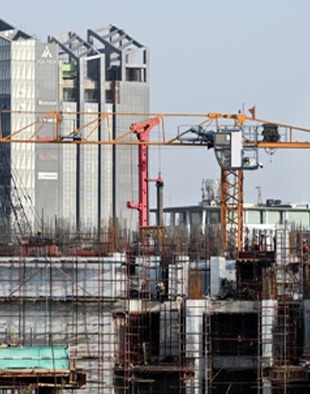
Institutional investments in India's real estate market are expected to reach a staggering $10.4 billion, according to a recent report
By Bricksnwall | 2025-12-22

Institutional
investments in India's real estate market reached their peak in 2025. This
represented a 17% rise compared to the previous year's impressive $8.9 billion.
India's
real estate market is poised for a remarkable leap in 2025. Institutional
investments are forecasted to hit a staggering $10.4 billion, spread across 77
transactions. This would mark the second year in a row of record-breaking
activity. The anticipated figure is the highest ever recorded, reflecting a 17%
jump from the previous year's impressive $8.9 billion, as detailed in a report
from JLL, a leading real estate consultancy.
The
ongoing strength of India's real estate sector underscores its appeal to
institutional investors. This string of record-breaking results firmly
establishes India's real estate market as a highly dynamic and swiftly changing
investment environment within the Asia-Pacific, suggesting significant
prospects for further institutional involvement and market growth.
Beyond
the immediate financial exchanges, 2025 saw substantial platform commitments,
reaching a total of $11.43 billion, earmarked for phased implementation over
the subsequent three to seven years. A significant portion of this commitment,
$11 billion, originates from a single platform agreement. This deal was forged
by Digital Connexion, a strategic joint venture involving Reliance Industries
Ltd., Brookfield Asset Management Ltd., and Digital Realty Trust Inc., all
focused on data centers. The remaining funds are designated for forthcoming
commercial and residential development initiatives.
"Real estate's institutional investment sector is set to deliver outstanding results in 2025. We're anticipating around $10.4 billion in capital spread over 77 transactions. This is a remarkable feat, building on the record-breaking activity we saw in 2024," stated Lata Pillai, Senior Managing Director and Head of Capital Markets, India, at JLL.
For
the first time since 2014, domestic institutional investors now hold a
significant 52% market share. Furthermore, the doubling of core asset
acquisitions in 2025 signals that investors aren't merely speculating on
India's future; they're actively constructing enduring wealth through our
established, income-producing properties. Pillai noted that this combination of
robust domestic institutional support and ongoing foreign confidence
establishes a unique basis for continued market growth.
Domestic
capital is reshaping India's real estate investment scene.
The report highlights a major change in 2025: domestic institutional investors seized a dominant 52% of the market. This was the first time domestic capital had taken the lead since 2014. It's a stark departure from the 2015-2024 period, when foreign institutional investors held sway. The current situation also contrasts with the years following the global financial crisis (2010-2014), when domestic funds, seeking opportunities, initially fueled market activity.
Indian
Real Estate Investment Trusts (REITs) and Infrastructure Investment Trusts
(InvITs) are driving this shift, having invested $2.5 billion, which is 56% of
all core asset purchases. Indian private equity firms have also played a
significant role, providing 30% of the total capital deployed within the
country. This development signals the Indian REIT market's evolution and the
increasing trust institutional investors place in these complex real estate
investment structures, as the report indicates.
2025 saw a significant shift in India's real estate investment scene. Office properties once again became the go-to destination for institutional capital, pulling in $6 billion. This figure represented a more than twofold increase compared to the year before. Dr. Samantak Das, Chief Economist and Head of Research and REIS, India, JLL, noted that two-thirds of these investments were funneled into prime core office properties. This clearly showed a strong institutional preference for stable, income-producing assets located in well-established commercial markets.
Source:
Hindustan Times