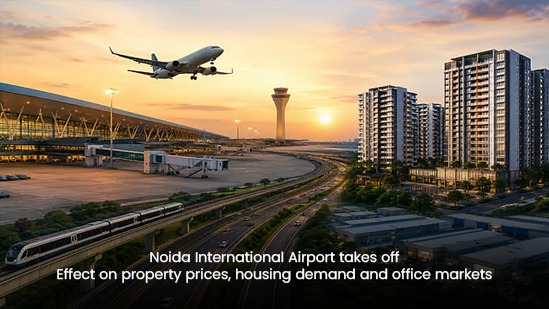
Noida International Airport takes off: Effect on property prices, housing demand and office markets
By Bricksnwall | 2026-10-01
Noida International Airport inaugural flight
heralds a new boom phase for the Yamuna Expressway region, with the airport to fuel real
estate demand.
The airport, which will see its first
commercial flight touch down on June 15 at Jewar, has the potential to become
much more than just a portal for air travel. Like other aerotropolis hubs
around the world, it is expected to anchor a wider ecosystem of industries,
logistics parks, and commercial development along the Yamuna Expressway
corridor, creating jobs, attracting investment, and fueling long-term housing
demand.
The Jewar region is being developed on a
combination of aviation infrastructure, logistics parks, industrial clusters,
business districts, residential communities, and commercial centers, like the global model of Schiphol in the Netherlands. Better connectivity through
expressways, freight corridors, and multimodal transport networks is intended to
make the region more attractive for investment and to cut travel times
dramatically.
With the economy picking up, the home market
is likely to feel the impact. A substantial percentage of housing demand is
focused on areas within 15 km of the airport, particularly Sector 22 on the
Yamuna Expressway, where numerous top developers have introduced residential
townships and integrated complexes.
Effect on housing markets
As per a report by Square Yards, Runway to
Realty: How Noida International Airport is Reshaping Realty, the apartment
prices along the Yamuna Expressway corridor are expected to increase
approximately three times between 2020 and 2025, while the plot values are set
to increase by an average of 1.5 times. Some micro-markets have seen property
values increase as much as five times due to the development of infrastructure,
industrial growth, and more jobs.
The momentum is likely to continue. The
survey predicted plot prices may rise a further 28% and apartment values by 22%
in the following two years, backed by sustained improvement in connectivity,
livability, and economic activity.
“The larger story around Jewar goes much
beyond the airport itself,” says Rahul Purohit, co-founder & CBO of Square
Yards. The region is being developed as a major logistics and warehousing hub,
with the cargo infrastructure projected to be a major driver of economic
activity. This commercial & industrial development is expected to provide
the employment possibilities and in turn support the long-term residential
demand across the Yamuna Expressway corridor.
Several developers have already set
themselves up to capitalize on this trend. Planned commercial constructions are
planned to bring significant growth potential to the area.
Purohit said that the prospect still looks
appealing for real estate investors despite the rapid gain that has already
taken place. He draws a parallel between the region’s journey and the regions
around Navi Mumbai’s Panvel and Bengaluru’s international airport, where early
investors are now seeing big returns. However, he warns that Jewar should be
seen as a long-term investment story rather than a quick flip chance. It was a
decade ago that investors entered the Yamuna Expressway market when prices were
Rs 4,000 per sq ft. “Prices are now around Rs 11,000 per sq ft, but the story
is still developing,” he said.
The price of a standard three-bedroom flat in
the region is in the range of ₹1 crore to ₹2 crore. Studio flats are also
coming up as an investment alternative, with projects offering units of around
600 sq ft for around ₹85 lakh.
Purohit thinks that residential investments
in the Yamuna Expressway corridor can fetch 12-13% annual returns in the long
term, providing investors the opportunity to adopt a patient strategy and remain committed through
the next phase of growth in the region.
He said investors need to be prepared to keep
assets for at least 5 to 7 years while commercial projects, logistics parks, and
employment hubs come on stream. With job growth gaining momentum, demand for
housing should continue to grow at a steady pace, supporting further price
appreciation.
Real estate developers say job creation will
increase house demand near Noida International Airport.
Developers think that the airport, logistical
hubs, industrial parks, and manufacturing clusters will lead to job creation,
which will keep the demand for homes sustained across the Yamuna Expressway
corridor. The first demand is likely to focus on the mid-income and inexpensive
segments, including studio apartments, with premium and luxury housing picking
up as the economic ecology of the region grows.
"Cities are not built by airports alone,
but by the ecosystem they unlock," stated Manoj Gaur, CMD, Gaurs Group.
Noida International Airport has supplied the initial impetus, but it is the
industrial parks, institutional infrastructure, and planned developments like
the leather manufacturing park, toy park, and electronics city that will sustain
and scale growth. These initiatives are collectively defining consumer mood
along the Yamuna Expressway, and this is reflected in the demand for larger
homes, integrated townships, and luxury residential buildings.”
"YEIDA’s recent predictions show that
the demand for housing, from inexpensive and mid-income homes to luxury
residences and studio apartments, will surge dramatically in the region with
the creation of jobs on a big scale. “We are also looking forward to developers
launching new residential, commercial, and mixed-use projects catering to the
growing workforce and business ecosystem,” said Dinesh Gupta, president,
CREDAI, Western UP.
“The company expects a fresh wave of
residential developments, commercial projects, business parks, and integrated
townships as developers respond to the growing requirements of professionals,
entrepreneurs, and investors seeking to be part of this emerging growth
corridor,” said Shree KB Group founder Rakesh Singhal.
As employment prospects and corporate
investments grow, there will be a significant surge in the demand for premium
homes, luxury flats, studio apartments, and quality commercial spaces.
“Developers are looking at new opportunities across residential, retail, and
office segments to address the changing needs of end users and investors,” said
Himanshu Garg, Director, RG Group.
“With the airport now improving access to the
global business networks and reducing travel time, the Noida Expressway is no
longer seen merely as a residential stretch but more as a self-sustained urban
destination with long-term investment depth,” says Yukti Nagpal, Director,
Gulshan Group.
“What was once considered a peripheral
stretch is now fast turning into one of the promising growth corridors of NCR,”
says Salil Kumar, Director, Marketing and Business Management, CRC Group. The
Noida International Airport has been a big catalyst, but it is the synergistic
impact of infrastructure, policy thrust and investor appetite that is really
accelerating the tempo. This is a window of opportunity for us as developers
with contemporary infrastructure meeting future-ready urban planning.
Commercial Real Estate Impact
The job ecosystem is anticipated to be varied
across logistics, warehousing, aviation, commercial services, and manufacturing,
creating opportunities for blue-collar and white-collar professionals alike.
This broad-based demand can be good for a number of housing classifications,
from inexpensive dwellings to premium apartments.
With an already developing economic and real
estate foundation, along with improved global connectivity, the Noida
International Airport (NIA) is projected to act as a structural catalyst for
the next phase of evolution of the NCR real estate. “As a second international
gateway for the region, with an initial capacity of 12 million passengers and
long-term scalability to 70 million, the airport is expected to strengthen the
region’s integration with global business networks,” said Supriya Chatterjee,
Managing Director, North, Cushman & Wakefield.
Noida’s hospitality sector is currently
underpenetrated. With the rise in business travel, transit flows, and MICE
activity, demand for hotels and convention facilities is projected to be driven. Retail total inventory sits at 8.1 MSF, of which only around 30% is Grade A+,
leaving tremendous headroom for premium formats. Chatterjee said the airport
will likely boost footfall and corporate presence, leading to additional
mixed-use retail projects based on destinations.
This is based on excellent fundamentals for
the office segment. Currently, Noida’s office stock stands at 43.4 MSF,
including a Grade A+ supply of 26.6 MSF, which shows a robust increase in
investment-grade assets in the last five years. The lease activity in 2025
stood at 4.7 MSF. NIA stands to build on this strength by attracting higher-value occupiers that may lead to deeper absorption and further boost the city’s
Grade A+ profile. GCC activity has also risen to ~2 MSF, supported by state
incentives and a strong talent environment. With this strong base, the airport
is expected to maintain the demand coming from the GCC, he added, saying
increased global access may also entice multinational corporations to
consolidate, grow, or set up operations in Noida.
Noida International Airport, Jewar Noida
International Airport: All about Jewar
Noida International Airport, located in the
Gautam Buddh Nagar district in the Yamuna Expressway Industrial Development
Authority (YEIDA) area, is one of the Uttar Pradesh government’s flagship
infrastructure projects and is expected to strengthen the state’s position as a
major aviation, logistics, and economic hub.
The first phase of the airport has been
finished and has the capacity to handle 12 million passengers a year. The
operational infrastructure consists of a runway, an integrated terminal
building, and an air traffic control tower. The airport was granted an aerodrome
license by the Directorate General of Civil Aviation (DGCA) on March 6,
2026.
The airport will be developed in four phases,
covering an area of about 1,334 hectares. Official predictions estimate annual
passenger capacity to be increased to 30 million by 2031, 50 million by 2036,
and 70 million by 2040.