Delhi-Meerut Metro: RRTS stations, route and latest updates
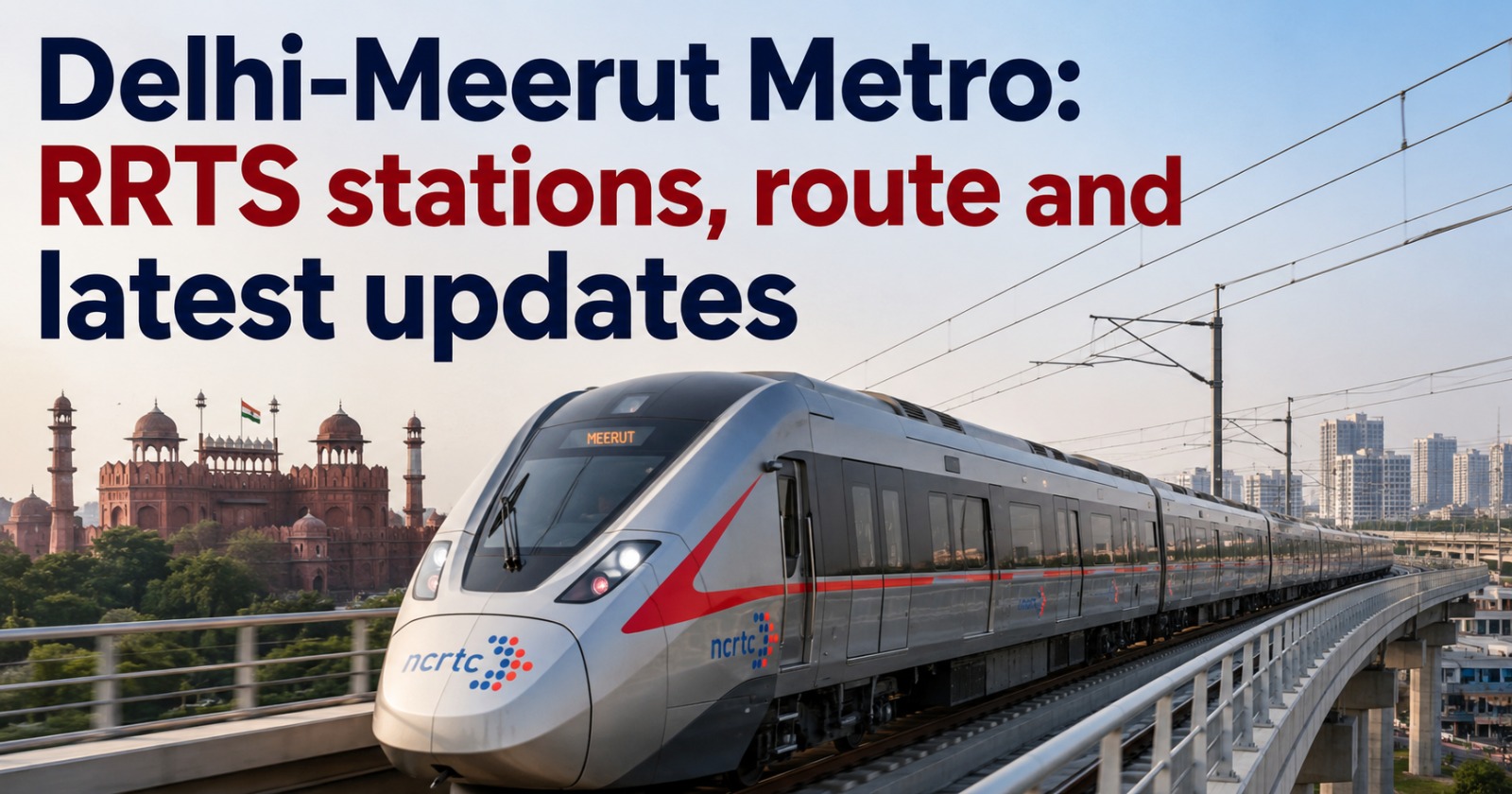
Delhi–Meerut Regional Rapid Transit System
(Delhi–Meerut RRTS), informally known as Rapid Rail,[16][17] is an 82.15 km
(51.05 mi)-long semi high-speed rail regional transit corridor that connects
the cities of Delhi, Ghaziabad and Meerut in the National Capital Region.[ It
is the first of the four rapid rail routes planned in the first phase of the
Namo Bharat project being implemented by the National Capital Region Transport
Corporation (NCRTC). It has a design speed of 180 km/h (110 mph) and employs
the Namo Bharat (trainset) designed by French rolling stock manufacturer Alstom
at its Hyderabad, Telangana engineering unit and produced in Savli, Gujarat.[2]
The train is aerodynamically designed to reduce drag during travel and can
reach speeds of up to 160 km/h (99 mph). It can cover the distance from Delhi
to Meerut in under 60 minutes. The project has been developed at a cost of
US$3.2 billion (₹30,274 crore). The corridor from Jangpura will pass through
Sarai Kale Khan, which will be the termination point for the three planned
corridors in Delhi, and end at Modipuram in Meerut. It has 16 stations and two
depots at Duhai and Modipuram.
Construction work on the Delhi–Meerut RRTS
commenced in June 2019. Originally, it was scheduled to be fully commissioned
in 2024, but the system had a series of delays and was only partially
operational from October 2023 to February 2026.
It has been rolled out in phases, beginning
with a 17km priority corridor between Sahibabad and Duhai Depot that opened
months behind schedule.Extensions to Modinagar North (6 March 2024), Meerut
South (18 August 2024) and New Ashok Nagar (5 January 2025), which had
initially been scheduled for earlier dates in 2024 and 2025, likewise missed
their respective deadlines by several months. Consequently, the whole 82.15 km
corridor from Sarai Kale Khan in Delhi to Modipuram in Meerut did not meet
three successive dates for full operationalization.
The civil works, testing
and trial runs were completed by October 2025, while the remaining lengths were
closed till February 2026. Earlier officials said the entire operation would
start only after it is formally inaugurated by the Prime Minister of India.The
corridor is operated by DB RRTS Operations India, a division of Germany’s
Deutsche Bahn. RRTS became the first regional transit system of India on
inauguration and is also tagged as the quickest rapid transit train of the
country with an operational speed of 160 km/h (99 mph).
Context
The Planning Commission constituted a task
force in 2005 under the Chairmanship of the Secretary, Ministry of Urban
Development, to develop a multi-modal regional transit system for the NCR. The
burgeoning population, traffic, congestion, pollution and risk of accidents and
mishaps in the National Capital Region, necessitated the need for a multi-modal
regional transit system. This was part of the Integrated Transport Plan for NCR
2032, with a special focus on a Regional Rapid Transit System (RRTS) linking
regional cities. In 2013, the Government of India and the Government of Delhi
took a decision to design a master plan for the development of a regional
railway which would directly connect Delhi with the bordering towns and regions
of the NCR and beyond. Hence, it was decided to set up the National Capital Region
Transport Corporation in July 2013 as a joint venture of the Government of
India and the governments of the states of Delhi, Haryana, Rajasthan and Uttar
Pradesh. The purpose of this organisation is to lessen the dependence of
commuters on road based transportation and improve regional connectivity within
NCR and beyond and develop, own and operate the Regional Rapid Transit Systems
(RRTS). The RRTS systems would be mostly underground in Delhi and will connect
with the Delhi Metro and will give the passengers a choice of speedier way as a
last mile connectivity way to reach their respective destination. They will be
similar to other regional transit systems in the world as London’s Crossrail,
Paris’ RER, and Munich’s S-Bahn. Originally, eight routes of no less than 1,000
km (620 mi) were scheduled to be implemented, then increased to nine. Of the
nine, four corridors are to be implemented in the next few years: Delhi-Meerut,
Delhi-Alwar, Delhi-Panipat and Ghaziabad-Jewar corridors. The Delhi–Meerut
corridor was selected to be created first because of high frequency of
travellers and traffic between Delhi and Meerut. The Government of India,
respective state governments and the NCRTC appointed feasibility studies and
then approved the corridor's construction.
History
The feasibility study and comprehensive
project report provided by National Capital Region Transport Corporation was
authorized by the Government of Uttar Pradesh in May 2017. The Government of
India approved the project implementation in February 2019, and also granted
finance of ₹30,274 crore (US$3.2 billion). The foundation stone of the route
and Meerut Metro project was placed on 8 March 2019. Construction for both the
projects began in June 2019.[35] The metro has been extended along the RRTS
line in Meerut for local connectivity across 21 km (13.0 mi). The NCRTC had
intended to commence regular operations on the 17 km (10.6 mi) long priority
segment from Sahibabad to Duhai Depot by March 2023.[37] But the project was
delayed due to work pending at several of the stations, especially Ghaziabad.
It was hence inaugurated and launched on 20th October 2023.[8] In July 2022,
the NCRTC awarded Deutsche Bahn, the national railway operator of Germany, to
run and maintain the corridor for 12 years with an option for another 5 years
as part of the contract. So following the opening of the corridor, the business
launched a new subsidiary called DB RRTS Operations India.The NCRTC named the
service provider as RapidX and the trains as Namo Bharat.
In December 2023, NCRTC announced that an
additional 25 km (15.5 mi) segment from the Duhai Depot to Meerut South will
probably be opened by March 2024 after successful trial runs, increasing the
operating length to around 42 km (26.1 mi).[41] The section was subsequently
extended to Modinagar North on March 6, 2024, Meerut South on August 18, 2024,
and New Ashok Nagar on January 5, 2025, the operating length increasing to
approximately 34 km (21.1 mi), 42 km (26.1 mi) and eventually 55 km (34.2
mi).[42][10][11] The remaining stretch from Sarai Kale Khan to New Ashok Nagar
over the Yamuna river was completed by June 2025; it is 16.6 km (10.3 mi) long.
NCRTC decided to develop a station at
Jangpura, Delhi for the ending station of the route in November 2021. The
original concept was to set up a stabling yard and operations control centre at
Sarai Kale Khan and manage from there the three pathways emanating from it.
However, the Jangpura station was constructed to provide connectivity to the
RRTS to people of Jangpura and surrounding regions, especially so because of
the congestion along Mathura Road. The total number of stations in the corridor
is 16. The station will be at grade and is likely to be constructed and
operational after the remainder of the route.[26] The rest of the corridor to
Modipuram is likely to be operational by July 2025.
Route
Of the total length, 68.03 km (42.27 mi) is
raised, 14.12 km (8.77 km) is subterranean and the remaining 1.45 km (0.90 mi)
section is at-grade for connections to two depots, located at Duhai and
Modipuram.22 In the congested suburbs of Delhi and Meerut, the line is
underground.The entire line is built for a maximum speed of 180 km/h (112 mph)
at a service speed of 160 km/h (99 mph). Average speeds are close to 100
km/h (62 mph).
The corridor is proposed to start at
Jangpura, but currently it starts from the Sarai Kale Khan station, as the
station at Jangpura is still to be built. Sarai Kale Khan is the terminal
station of all the corridors planned in the region. The corridor traverses
several suburbs of Delhi and Ghaziabad and terminates at Modipuram in Meerut.
The Sarai Kale Khan station is the largest of all stations with three storeys,
six platforms and six tracks to cater the three corridors to Meerut, Panipat
and Alwar. It is a terminal and location specific multi-modal transport hub
with direct connectivity to the adjoining transport systems and facilities in
its vicinity like Sarai Kale Khan-Nizamuddin metro station of Delhi Metro,
Sarai Kale Khan Inter-State Bus Terminus and the Hazrat Nizamuddin railway
station.
The Anand Vihar station of the corridor holds
similar strategic importance due to its proximity to the Anand Vihar Terminal
railway station, while the Ghaziabad station is another connectivity hub with
three more proposed corridors: Ghaziabad–Jewar, Ghaziabad–Bulandshahr–Khurja
and Ghaziabad–Hapur.
Since January 2025, just a short corridor (55
km (34.18 mi)-long) from New Ashok Nagar in Delhi to Meerut South portion was
operating. The Sarai Kale Khan to New Ashok Nagar stretch saw repeated
delays,[43] and was opened in February 2026; with this, the full corridor
became operational.
Construction
The National Capital Region Transport
Corporation has split the civil construction work of the RRTS project into
eight packages and 30 packages for all stations, ramps, tunnel sections and
technical facilities, including 16 stations and two depots. Out of these eight
packages, two packages of Meerut sector are also a part of Meerut Metro
project. The complete list of all packages, contractors and statuses is as
follows:
Phases | Description | Opening | Status |
1 | October
2023 | Completed | |
2 | Duhai
Depot to Meerut South | March-August
2024 | Completed |
3 | Sarai Kale Khan to
Sahibabad | January
2025 | Completed |
4 | June
2025 | Completed |
Package-1 and Package-2 are part of the
priority portion of the RRTS while Package-7 and Package-8 are part of Meerut
Metro.
|
Package |
Description |
No of Stations |
Contractor(s) |
Status |
|
1 |
Sahibabad
Ramp – Ghaziabad Station |
2 (elevated) |
KEC International and China Civil Engineering Construction
Corp. (JV) |
Completed |
|
2 |
2
(elevated) |
Apco
Infratech and China Railway First Group (JV) |
Completed |
|
|
3 |
Muradnagar, Modinagar South, Modinagar North, Meerut South, Partapur, Rithani and Shatabdi Nagar |
7
(elevated) |
Completed |
|
|
4 |
New Ashok Nagar Ramp – Anand Vihar – Sahibabad
Ramp |
1
(underground) |
Shanghai
Tunnel Engineering Co. (STEC) |
Completed |
|
5A |
Duhai
Depot and Workshop (at-grade, |
1 (Depot) |
Vijay
Nirman Co. and KEC International (JV) |
Completed |
|
5B |
Modipuram
Depot and Workshop |
1 (at-grade) |
KSM
Bashir Mohammad & Sons |
Under construction |
|
6 |
Sarai Kale Khan and New
Ashok Nagar |
2
(underground and elevated) |
Completed |
|
|
7 |
Shatabdi
Nagar–Brahmapuri Down Ramp–Brahmapuri–Begumpul Down
Ramp–MES Colony, Daurli, Meerut North and Modipuram |
5
(underground and elevated) |
L&T
Heavy Civil Infrastructure |
Completed |
|
8 |
Brahmapuri
Down Ramp–Meerut Central, Bhaisali and Begumpul RRTS station–Begumpul
Up Ramp |
3
(underground) |
Afcons
Infrastructure |
Completed |
|
9A |
Multistoried
Staff Quarters and Connectivity |
Sam
India Builtwell |
Under Construction |
|
|
9B |
Construction
of Jangpura stabling yard, Operation control
center (OCC) and associated buildings |
Bidding
process underway |
The project's foundation stone was placed in
March 2019 and building started in June 2019. But it took longer beyond the
scheduled time due to extra work coming up at several stations especially
Ghaziabad," said a railway official. It was finally opened on 20 October
2023. The entire route from Sarai Kale Khan to Meerut, which was supposed to be
operational by September 2025, has started functioning only from February
2026.
The length of the corridor in operation was
gradually increased. It was extended to Modinagar North from Duhai Depot on 6
March 2024. Total length is roughly 34 km (21.13 miles)). It was extended to
Meerut South on 18 August 2024, making its operational length about 42 km
(26.10 miles). On 5 January 2025, the corridor was extended to New Ashok Nagar,
and the entire length of the operational corridor became about 55 km (34.18
miles). On 22 February 2026, the corridor was extended to Sarai Kale Khan in
Delhi and Modipuram in Uttar Pradesh, thus reaching to its fully-planned length
of 82.15 km (51.05 miles)
Stations
The RRTS corridor will commence at Jangpura
where work is in progress and will pass via Sarai Kale Khan. Both the stations
are in Delhi. It then passes through Ghaziabad, where three further corridors
to Jewar, Hapur and Khurja have been proposed to link the adjacent towns and
cities of Uttar Pradesh with the National Capital Region, before terminating at
Meerut. There are 16 stations in the corridor of which 9 stations will be extra
stations which will be intermediate stops for Meerut Metro where RapidX
services will not stop. However, some stations such as Meerut South, Shatabdi
Nagar, Begumpul and Modipuram have integration of RRTS and Meerut Metro, and
stoppage for both services is permitted. Currently, the route includes 15
operational stations and one depot, with Jangpura station under development.
The stations’ exterior designs are based on the color of the feathers of the
peacock, the national bird of India.61. The list below details the stations,
their integration with existing transit modes and their state.
|
Delhi–Meerut RRTS |
||||||||
|
No. |
Station Code |
Station Name |
Integration |
Station Layout |
Platform Level Type |
Status |
Opening |
|
|
English |
Hindi |
|||||||
|
1 |
Jangpura |
जंगपुरा |
None |
Side |
Under-Construction |
- |
||
|
2 |
सराय काले खान |
Elevated |
Side/Island |
Operational |
22 February 2026 |
|||
|
3 |
न्यू अशोक नगर |
Elevated |
Side |
5 January 2025 |
||||
|
4 |
आनंद विहार |
Underground |
Island |
|||||
|
5 |
साहिबाबाद |
None |
Elevated |
Side |
20 October 2023 |
|||
|
6 |
ग़ाज़ियाबाद |
Elevated |
Side/Island |
|||||
|
7 |
गुलधर |
None |
Elevated |
Side |
||||
|
8 |
दुहाई |
None |
Elevated |
Side |
||||
|
9 |
दुहाई डिपो |
None |
At-grade |
Side |
||||
|
10 |
मुराद नगर |
None |
Elevated |
Side |
6 March 2024 |
|||
|
11 |
मोदीनगर दक्षिण |
None |
Elevated |
Side |
||||
|
12 |
मोदीनगर उत्तर |
None |
Elevated |
Side |
||||
|
13 |
मेरठ दक्षिण |
Elevated |
Side |
18 August 2024 |
||||
|
14 |
शताब्दी नगर |
Elevated |
Side |
22 February 2026 |
||||
|
15 |
बेगमपुल |
Underground |
Island |
|||||
|
16 |
मोदीपुरम |
Elevated |
Side |
|||||
Funding source
Multilateral Funding: The Asian Development
Bank provided a loan of $1 billion, the New Development Bank provided a loan of
$500 million and the Asian Infrastructure Investment Bank provided a loan of
$500 million to the National Capital Region Transport Corporation for the
building of the RRTS.
Government Contributions: Government of India
: 20 % Government of Delhi : 3.22 % Government of Uttar Pradesh : 16.78 %
Updates
August 2023:
Tunneling work of RRTS is totally completed.
20 October 2023: Inauguration of priority corridor between Sahibabad and Duhai.
Dec 2023: Trial
run on 25-km stretch from Duhai to Meerut South was done.
February 2024: NCRTC said the 25 km link between Duhai and Meerut South will be
operational by March 2024, taking the total operational stretch to 42 km. Both
the RRTS and Meerut Metro projects are expected to be finished by June 2025.
Mar 2024: The
17-km-long stretch up to Modinagar North of the 25-km-long line from Duhai
Depot to Meerut South was opened on 6 March 2024 and the operating length was
at 34 km at present. Meerut South station to be finished in May 2024 (1st part).
Aug 2024: 25 km
long from Duhai Depot to Meerut South, 8 km segment from Modinagar North to
Meerut South opened on August 18, 2024. The overall length of the corridor is
82 Km out of which more than 80 km has been built and the portion from
Sahibabad till Sarai Kale Khan is on pace to be completed by December 2024.
Jan 2025: 13 km
segment between Sahibabad and New Ashok Nagar inaugurated on 5 January 2025
connecting Delhi with the corridor.May 2025: NCRTC has finished installation of
all 169 track km (TKM) of precast slab track.
22 February 2026 – Entire section of RRTS from Sarai Kale Khan to Modipuram becomes
operational.
Home Cleaning Tips for a Fresh Start This Monsoon
The first droplets of rain are always something magical. The overcast sky, the cold wind and the fragrance of wet earth after weeks of blazing heat seem like nature’s blessings. But along with the relief, the rainy season also brings in an unseen obstacle that every homemaker dreads – humidity, wetness, mould, vermin and bad smells inside house.
If you have ever entered your kitchen and smelt something musty or entered your bedroom and found a damp odour coming from cupboards, you already know how monsoon silently creeps into every corner of the home.
So now, let’s see the major problems that the rains bring, and learn basic monsoon cleaning tips that will keep your home gleaming, fresh and germ-free.
Why Monsoon Cleaning is So Important
The rainy season brings high humidity, which is a wonderful setting for mold, bacteria and fungus. Carpets, wooden furniture and even clothes collect moisture and the whole house seems wet.
Cockroaches and mosquitoes are attracted to stagnant water in sewers. Fungus thrives in dirty kitchens and musty cupboards can spoil your favorite clothes.
But there’s more. The wetness of the rainy season is also associated with health concerns. Monsoon has lots of complaints from many including cough, allergies, skin infections, breathing problems etc. Who's the culprit? Air that is wet and carries spores of mold and bacteria.
The good news is that with a few conscious habits and a proper cleaning routine, you can enjoy the rains without any worries about odors, germs or pests.
1. Kitchen Monsoon Cleaning Tips: Preventing Mold Before It Begins
The kitchen is the heart of every home but in monsoon it is also the first thing to get affected by mold, fungus and unpleasant odour. The moisture around the sink, tiles and corners is a good place for bacteria to proliferate easily.
Kitchen Problems During Rainy Season
Mold on sink edges and tile grout
Damp scent from cupboards and shelves
Humid conditions speeding the decay of food items
Best Kitchen Cleaning Tips for Monsoon
Use a citrus kitchen cleanser to wipe down the counters, stovetops and tiles each day. Citrus reduces grease, fights germs, and leaves a fresh smell.
Wash the sink corners and backsplash tiles at least twice a week.
Keep storage areas dry and clean. Store beans, flours and spices in air tight containers.
Place tiny bowls of baking soda or cloves in the cupboards to absorb moisture and keep roaches away.
? Tip: Citrus cleaners are good for more than disinfecting. They stop bacteria from growing and help keep your kitchen smelling fresh.
Home Cleaning Tips for a Fresh Start This Monsoon
The first droplets of rain are always something magical. The overcast sky, the cold wind and the fragrance of wet earth after weeks of blazing heat seem like nature’s blessings. But along with the relief, the rainy season also brings in an unseen obstacle that every homemaker dreads – humidity, wetness, mould, vermin and bad smells inside house.
If you have ever entered your kitchen and smelt something musty or entered your bedroom and found a damp odour coming from cupboards, you already know how monsoon silently creeps into every corner of the home.
So now, let’s see the major problems that the rains bring, and learn basic monsoon cleaning tips that will keep your home gleaming, fresh and germ-free.
Why Monsoon Cleaning is So Important
The rainy season brings high humidity, which is a wonderful setting for mold, bacteria and fungus. Carpets, wooden furniture and even clothes collect moisture and the whole house seems wet.
Cockroaches and mosquitoes are attracted to stagnant water in sewers. Fungus thrives in dirty kitchens and musty cupboards can spoil your favorite clothes.
But there’s more. The wetness of the rainy season is also associated with health concerns. Monsoon has lots of complaints from many including cough, allergies, skin infections, breathing problems etc. Who's the culprit? Air that is wet and carries spores of mold and bacteria.
The good news is that with a few conscious habits and a proper cleaning routine, you can enjoy the rains without any worries about odors, germs or pests.
1. Kitchen Monsoon Cleaning Tips: Preventing Mold Before It Begins
The kitchen is the heart of every home but in monsoon it is also the first thing to get affected by mold, fungus and unpleasant odour. The moisture around the sink, tiles and corners is a good place for bacteria to proliferate easily.
Kitchen Problems During Rainy Season
Mold on sink edges and tile grout
Damp scent from cupboards and shelves
Humid conditions speeding the decay of food items
Best Kitchen Cleaning Tips for Monsoon
Use a citrus kitchen cleanser to wipe down the counters, stovetops and tiles each day. Citrus reduces grease, fights germs, and leaves a fresh smell.
Wash the sink corners and backsplash tiles at least twice a week.
Keep storage areas dry and clean. Store beans, flours and spices in air tight containers.
Place tiny bowls of baking soda or cloves in the cupboards to absorb moisture and keep roaches away.
? Tip: Citrus cleaners are good for more than disinfecting. They stop bacteria from growing and help keep your kitchen smelling fresh.