How Metro Connectivity Affects What Property Prices Buyers & Investors Should Know
By Bricksnwall | 2026-06-29
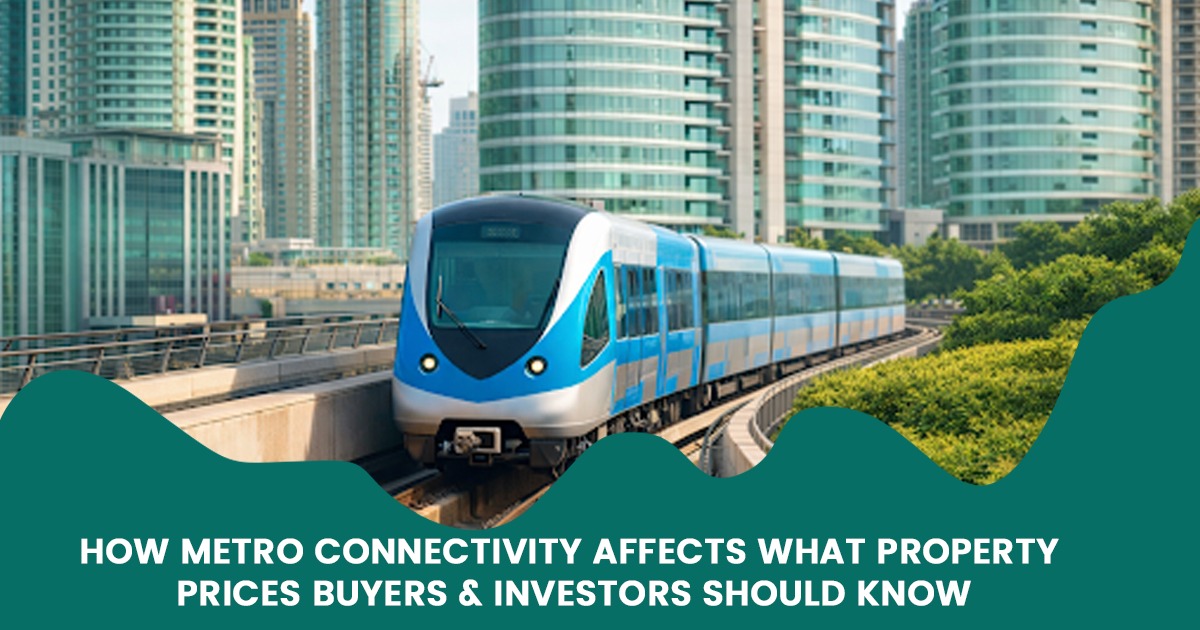
In today’s fast-urbanizing cities, long
commutes, traffic congestion and uncertain travel times have greatly affected
real estate prices. Connectivity has become a crucial element in judging
properties by home purchasers, in addition to price and amenities. The value of
real estate and metro connectivity are usually related; properties located near
metro corridors always enjoy a premium price due to better accessibility, less
travel time and better lifestyle comfort.
Properties close to metro stations are typically
in greater demand and are absorbed quickly. The shorter commute time helps
enhance the work-life balance, making these areas very attractive to
professionals and families alike. Properties with metro connectivity continue
to be a top priority for investors owing to their significant capital
appreciation and rental yield possibilities. Adequate transit infrastructure
also leads to massive urban expansion, increasing property markets around
it.
Let’s understand the influence of metro
connection on property prices and how it is transforming into a synonym for
future-ready real estate investment.
How Metro Connectivity Fuels Real Estate
Growth in India
There are several reasons why real estate
appreciation is stronger near metro lines:
More Rapid Transport and Improved
Accessibility
Metro networks deliver dependable, high-speed
transportation that enables inhabitants to conveniently access business
districts, commercial hubs and educational centers. This greatly boosts the
value of the location.
Less dependence on road traffic
Homes near metro lines also mean less
dependence on private vehicles, saving on fuel expenses, parking issues, and
commute stress—a big lifestyle advantage.
More demand from professionals and families
Another reason for property prices to be on
the rise near metro stations is that working professionals choose places that
provide easy access to their offices. Connectivity to schools, hospitals, and
retail areas is also a bonus for families.
Driver of the Urban Expansion
Metro corridors tend to create more new
residential areas, commercial clusters and infrastructural investments that
turn previously underdeveloped areas into high-growth real estate
markets.
How Metro Connectivity Impacts Property
Prices in India
The influence of metro connectivity on
property prices is easy to quantify:
Price appreciation of 15% - 35% compared to
non-connected locations for metro station proximity.
Suburban areas linked to the metro are
growing at a faster pace, thanks to improved connections, making them viable
residential options.
Even if the market slows down overall,
increased demand keeps prices stable in the long term .
Also, metro access boosts resale liquidity by
shortening time-to-sell.
Property Values and the Effect of Being Close
to Metro Stations
There is also a strong correlation between
metro accessibility and property value in India.
Let’s see how:

Greatest appreciation potential.
High rental demand near metro stations.
Great for regular commuting.
Premium pricing because of walkability.
Growth Potential & Pricing of Properties
within 500m-1km from Metro
Balanced supply and price
Robust long-term growth.
Ideal for families that desire convenience
but not the crowds.
Properties More Than 1km Away From Metro: Impact on Property Value
Moderate impact on home values.
The impact is contingent on the availability
of feeder transport and road links.
Walkability, last mile connectivity and
infrastructure quality are crucial to unlock property value in these
zones.
Stages of Real Estate Price Growth Near Metro
Projects
The increase in property prices near metro
stations usually follows a predictable pattern:
Announcement Phase: Prices normally increase
between 10% and 30% on anticipation of future connectivity.
Construction Phase: Infrastructure becomes
visible, market confidence increases, maximum appreciation.
Operational Phase: Prices are premium, often
around 5-20% higher than adjacent areas.
Typically, the properties near the metro have
larger investment benefits during the pre-launch and construction-stage
periods.
Metro Corridors: Business Growth and
Infrastructure Development
Metro networks foster economic growth in the
following ways:
More retail shops, malls and office spaces.
New commercial hubs and business areas are on
the rise.
Large employment creation and economic
activity.
Commercial property values may go up 20 to
25%.
Transit corridors also tend to become
mixed-use development zones.
What Property Investors Need to Know Before
Investing Near Metro Corridors
There are many investment advantages of homes
close to a metro but there are several strategic considerations you need to
make as an investor like:
The biggest appreciation is within 500 meters
of metro stations.
The sooner you invest during the design or
construction process, the greater your profits may be.
Focus on rising corridors and Transit
Oriented Development (TOD) zones.
Evaluate rental demand, liquidity and
infrastructure pipeline.
Metro-centric TOD initiatives tend to generate sustainable long-term demand.