Want to rent your place out short-term? Rules landlords need to know before the first renter arrives
By Bricksnwall | 2026-10-07
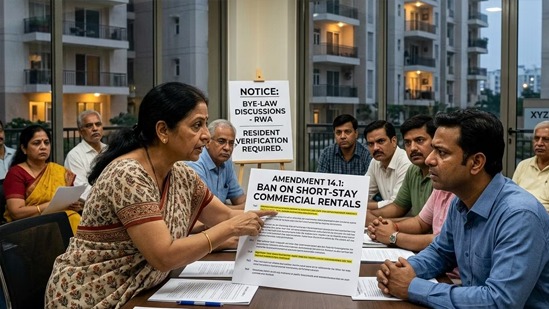
Noida and Ghaziabad residents are concerned about security and disruption as short-term rentals become more popular.
Short-term rentals in NCR have been under
scrutiny over the past few weeks, with residents’ associations in Noida and
Ghaziabad raising the alarm about security, disturbance, and the regular stream of
short-stay guests entering residential complexes. There is no blanket
legislation preventing homeowners from renting out flats for short-term stays,
but legal experts say it is far from a free-for-all.
Most housing societies are governed by state apartment ownership acts or cooperative societies acts and their own bylaws,
which may restrict or regulate transient occupancy. “The rules often come down to
security issues, the use of common areas, and whether a lot of short-term
rentals would take away from the residential nature of a housing complex," they
say.
The residents’ organization has cautioned
apartment owners and tenants against letting out homes for short stays on
Airbnb and other short-term rental sites, and Supernova in Sector 94, Noida, has
become the center of the issue. The move comes after an incident where a
short-stay accommodation operator in Spira made it to the Supernova complex and
reportedly tried to go in through the main gate, not the access allocated for
such purposes.
Security officers reportedly stopped him and
said he should use the tower's approved gate. He allegedly informed them that
one of his guests was held up at the reception and he wanted to go into the
building to check the guest in. The operator, who was apparently arguing with
the guards when they refused to open the gate, drove his car over the boom
barrier.
Separately, a software engineer killed
himself by jumping from the balcony of an Airbnb in Supernova’s Spira Tower on
October 3, according to allegations. Reports said the man had booked into the
flat alone on Friday and had bought dinner online.
The Supernova Apartment Owners’ Association
had put out a notice a few days previously, warning flat owners and tenants
against giving their homes on short-term rent. The group stated those listing
or renting out properties on such platforms could face legal action, and the
obligation would be with the respective unit owners or tenants.
Naresh K. Nandwani of the Supernova Apartment
Owners’ Association was quoted as saying the complex has three towers—Nova
East, Nova West, and Spira Tower. Nova East and Nova West are 100% residential
and collectively have 582 units, with Spira having a mixed-use component.
Nandwani added that some 200 flats between
the 19th and 43rd floors of Spira Tower are being used for commercial purposes,
including short-term housing. Residents have complained they are concerned
about visitors coming and going at strange hours, he said, despite the three
towers being on a shared site and gated.
“The general body meeting of the association
passed a resolution through a voice vote on September 30 saying owners should
not allow short-term rentals as they were creating problems and needed to be
discouraged and stopped,” Nandwani told Hindustan Times Real Estate.
A similar problem has cropped up in Ghaziabad
as well.
Last month, more than 30 residents of Windsor
Park Society in Vaibhav Khand held a protest march against the suspected
operation of short-term rentals in the residential complex and raised chants
like “this is not a hotel” and “no Airbnb." Residents had complained that
certain units were being rented out on an hourly basis and the constant
movement of outsiders was raising security issues. The main criticism was about
the studio flats in Towers A and B, which together include about 270 flats.
Residents said more than 50 flats were being utilized as Airbnb-style
housing.
What are the short-term renting restrictions
in UP?
Uttar Pradesh has a particular regulatory
regime for homestays and bed-and-breakfast establishments under its Bed &
Breakfast and Homestay Policy, 2025. The policy enables tourists to stay on
residential premises but only if they are registered and comply with the
specified restrictions.
The homestay must be a house where the owner
and family live and can offer a maximum of 6 rooms with a maximum of 12 beds. The B&B
category does not require the owner to live on the premises but requires a
caretaker to be on-site. The policy also restricts eligibility to lawful owners
of property and requires registration with the Tourism Department.
However, registration under the state tourist
policy does not immediately give a homeowner the right to run an Airbnb-type
rental in a housing society. Apartment by-laws, the deed of the apartment, and
resolutions approved by the residents’ association may place additional limits
on short-term or commercial use.
Can landlords rent their apartments on a
short-term basis?
There is no blanket central law that bans
short-term rentals in a residential apartment. But it's not a free-for-all
either, legal experts added.
Rajiva Singh, founder of Noida Federation of
Apartment Owners Associations, an apex representative body of high-rise
apartment owners and resident associations across Gautam Buddha Nagar, said,
“The Administration has made it clear that leasing out a whole residential
apartment on app-based Bed & Breakfast (BnB) platforms without the main
owner residing there is illegal and is an unauthorized commercial activity.
Short-term commercial rentals that are not
hosted can pose serious safety, security, and privacy hazards for residents, he
told Hindustan Times Real Estate. Hence, RWAs and AOAs generally prohibit
commercial activity in high-rise residential complexes to ensure community
safety.
“There is no grand central law against this,
but it’s not a free-for-all. “Most housing societies are registered under the
Apartment Ownership Acts or Cooperative Societies Acts of the state, and their
own bylaws often restrict or regulate short-term or transient occupancy, as
it impacts security, usage of common areas, and the residential character of the
building,” said Supreme Court advocate Amitraj Kaushal.
Therefore, the availability of a flat for
Airbnb-style stays by a homeowner depends on the bye-laws of the society, the
rules of the municipal or local authority concerned and, in some states,
particular requirements for homestays or paying guest accommodation.
Do we need authorization from RWA?
In most circumstances, the homeowner should
review the bylaws of the society and seek necessary authorization or give
prior information to the RWA or managing committee before initiating short-term
rental.
This may not be an absolute legal requirement in all
cases under the parent legislation, but usually processes for letting out a
unit are prescribed in society bye-laws. Some societies have also increased
restrictions on short-term or Airbnb-type rentals due to security and liability
issues.
“Non-compliance with these rules can lead to
disputes with the RWA, show-cause notices, or restrictions on the use of common
facilities depending on the society’s bylaws and enforcement mechanisms,”
added Kaushal.
Will short-term rentals be considered
commercial use?
This is still a gray area and may depend on
the frequency and scale of the activity.
A short-term letting of a residential flat
may be classified as residential usage for property-tax purposes, as long as it
is an infrequent or one-off lease. But if it is rented out often, is run like a
business, or is part of a bigger hosting operation, municipal authorities might
consider it to be commercial or mixed-use, particularly if the activity
resembles a hospitality business, he said.
The rental income has to be reported for
income tax purposes. Depending on the nature, scale, and frequency of the
activity, the revenue may have to be treated differently from conventional
income from dwelling property.
What can landlords do before putting a home
up for short-term stays?
1. Check the regulations of society: Please
read the bye-laws of the apartment association and get the appropriate RWA
notification or NOC before you start short-term rentals. This may assist in minimizing conflicts and potential limitations on amenities.
2. Keep Good Tax Records: Keep receipts of
rental revenue and report the income on tax returns. Where activity is large or
businesslike, get professional guidance as to whether it should be considered
as income from residential property or business income.
3. Research local laws: Check local and
state-specific requirements for short-term rentals, homestays, B&Bs, or
paying guest lodging. The compliance criteria may differ from place to place, and
infractions may result in action irrespective of any dispute with the housing
society.
Source: Hindustan Times